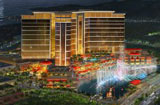
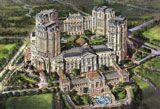
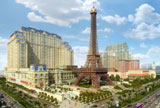
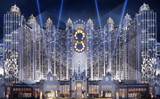
Macau Taipa Cotai Strip

Wynn agrees to govt’s offer to his land

My, we are impressed. Just when everyone thought it was impossible to get a new piece of land in Cotai, Steve Wynn pulls one out of the bag.

According to the company’s disclosure to the HK stock exchange this morning, Wynn Macau SA (the gaming concessionaire) and a company called Palo Real Estate (also owned by Wynn) have agreed to the terms offered by the government for the 51-acre plot in Cotai that has had Wynn’s boardings around it for a few years now.

The terms, as outlined, are:

1) Palo will lease the land from the government and pay all the premiums (about HK$1.5bn);

2) Wynn will be “required” to operate a casino on the site;

3) The land must be developed within five years of the concession being gazetted.

Well, we suppose congratulations are in order. This is quite an accomplishment. The only pity is that it couldn’t have been announced last week by Ian Coughlan and Linda Chen as they cut the 5th birthday cake in front of staff.

As mentioned last week, Wynn Macau has been doing relatively well lately, but not as well as its Chinese relatives. Moreover, momentum has clearly started to shift to Cotai, and this will likely accelerate once Lot 5+6 starts to open next April. So even among the three American companies, Wynn had been increasingly seen as more like MGM than Sands China. This announcement, if it really is a firm agreement that just needs to be rubber-stamped before being gazetted, changes everything. It puts Wynn back in the “we have a development plan” game.

Comparisons with Sands China are probably still not really valid, of course. They play in different ballparks. And there is still much to be worked out for Wynn before the clock starts ticking on its new land concession. A formal announcement in the government gazette might still take months. So Lot 5+6 might get quite a head start by opening a few years before Wynn.

However, there can be little doubt that Wynn will not have any of the same problems as Sands has had in getting its own project open. There is major upside ahead for this company once again and we think there are several reasons to believe it can get the project open well before its 60-month timeline expires. Moreover, we think that when it is open, it will be a sensation. It’s time to reassess the company. Again.  Used with permission and copyright IntelMacau.com

Wynn Macau turns 5 – Happy Birthday !

Can it really be five years ago that the “new Macau” started in earnest when Steve Wynn opened the classiest joint in town? How time flies. We remember the party well, with the big shot and his then-wife dancing to the tune of “I need a hero” in front of the gyrating fountains.

Today, several billion US dollars in revenues later, the Las Vegas Review Journal wrote a nice report to mark the anniversary by noting that things have never been better for the iconic resort. Respectfully, we beg to differ.

Perhaps this is nit-picking, but things have been better, competitively speaking. While we could fully understand if Wynn himself were to be thanking his lucky stars for the success of his Macau property, especially since Vegas went into the tank in 2008, and he would probably be the first to admit that he never imagined he could be making this much money from it today, we wonder if that’s really enough for him.

It’s not that he hasn’t yet received approval for his Cotai land. We have no doubt that will come, eventually. How could any government be ungrateful to someone who had pledged to donate more than a billion patacas to help build its new university campus in Hengqin? And once the concession is gazetted, we presume Wynn Macau will no longer need to keep adding a paragraph to its interim and annual reports detailing the US$50m payment that needs to be made to an undisclosed third party to relinquish its rights to the land, as the Macao Post noticed this week.

No, it’s not that. It’s that we can’t help but notice how Wynn Macau appears to be in the same boat as its fellow American gaming companies, rowing away as hard as they can while the Galaxy Entertainment Group steams past with smoke billowing from its exhaust, thanks to the recent addition of a second engine in Galaxy Macau.

Now, don’t get us wrong. We know Wynn doesn’t see itself as a competitor of GM. Its mass floor still does a lot more, especially at the high end over in Encore, and its Ebitda margins are a lot wider. But Wynn used to be the undisputed champion of the rolling-chip market. It still does more than any other single property in Macau (if that is a fair way of describing it since the addition of Encore). Nevertheless, Galaxy Macau has turned its owners into the clear leaders of the VIP market in Macau, if you discount all those third-party volumes accounted for by SJM.

Will Wynn be able to regain the title belt when it opens its own property in Cotai? Perhaps. When that eventually happens. But right now, there is no doubt where the momentum lies in this market. And it ain’t with the yanks. Happy birthday, Wynn Macau. Used with permission and copyright IntelMacau.com

Galaxy has our full attention

The best is yet to come for Galaxy Entertainment Group, which announced its first quarterly results since the opening of Galaxy Macau on May 15 – giving it just 47 days before the books closed. Since then, the property has gone from strength to strength, and now commands around 20% of the market. No other property in Macau has had such a dramatic impact upon opening, except the Venetian in 2007.

Critics might be quick to point out that topline numbers do not a success make, and Galaxy boss Francis Lui would be the first to admit it – in fact, he was the first to admit it at yesterday’s press conference, where he emphasized that his focus is on growing the bottom line. His new property obviously has a long way to go since its first 47 days, which threw off Ebitda of about US$1m per day – a step behind COD’s US$1.7m a day in Q2, and a long stride behind the Venetian’s US$2.8m a day in the same period. But it’s obvious that the only way that number is going is up; the question is just how fast.

From experience of watching this market, we would say it could take a bit longer to catch COD than many might expect. Mass, especially premium mass, is where the potential for margin expansion is most obvious, and Galaxy still has its work ahead of it in this segment. COD, by contrast, is hitting its stride, two years after opening. But it will come for Galaxy, too. And in the meantime, VIP marketing boss John Au is leaving his neighbors in his rear-view mirror, accounting for more than 60% of all new VIP volumes coming into Macau since the property opened.

That’s even before he opens another three rooms, or before the hotels are fully operational (another 800 rooms coming online by year-end), or before the China Rouge nightclub opens (important for VIPs).

Moreover, what most surprises us about the group’s performance so far is the boom that’s going on at StarWorld. We had been expecting the peninsula property to be seriously cannibalized by the Cotai resort’s opening. Instead, it is up on all counts: VIP, mass and non-gaming. Very impressive.

Indeed, as mentioned, we think there is a lot of fairway ahead of Galaxy right now. Until Lot 5+6 opens next year, in fact, we would not be surprised if Galaxy continues to grow its market share, perhaps all the way back to where it was when the Venetian opened, around 22-24%.

Why? Well, primarily because of its partners – Galaxy has the best relations with Sun City and Neptune of all the Macau casinos, and they currently appear to be in the ascendant. All the rest of their junket operators are solid, too.

But also because we think the management team has room to improve. To be sure, if this is how well they can perform in driving the top line so soon after opening, then it says something about how much they have to work with in improving margins. Starting with win-hold on mass – 17%, compared to the more normal 24% elsewhere – there is obviously work to be done in squeezing costs out of the system. But it’s like they say in the classics, the best way to make a small fortune is to start with a big one. As their bigger next-door neighbors are finding to their dismay, no doubt, you can’t grow your bottom line much if your top line isn’t growing.

And then there’s the real estate. We wouldn’t be surprised if Galaxy starts expanding asap, given that it has so much room to grow into. Watch this space. And stay tuned. Used with permission and copyright IntelMacau.com

Galaxy Macau photos August 2011

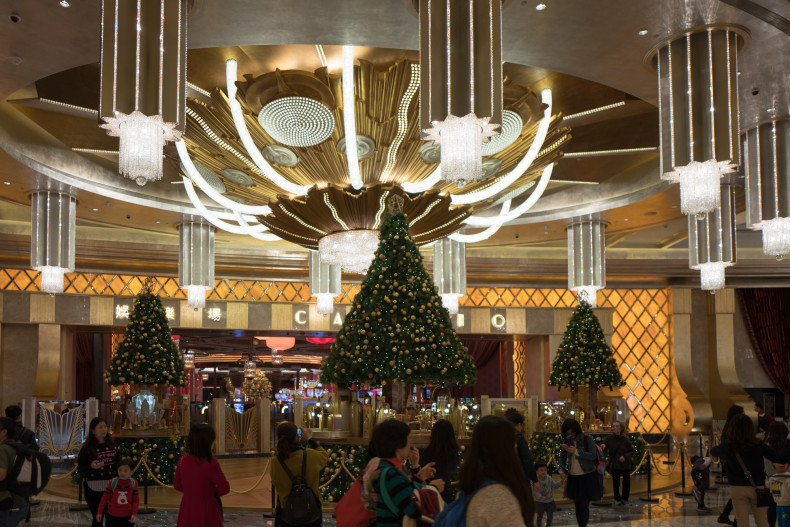
I really like the look and feel of the Galaxy Macau experience. The design is on par with expectation of such a mega resort and here are some photos I took during a brief visit on a hot August afternoon. This is another children friendly casino-resort and you can see many families check-in for the last weekend of the summer holidays.

Also, Galaxy Macau hosts the recent Volleyball World Grand Prix featuring the 8 strongest teams of USA, Japan, China etc. I even catch the Team USA volleyball athletes walking in the lobby from their lunch.  Within less than 50 days of openings,  report that this establishment already commands 20% of the gaming market. This is simply incredible!

Main lobby with a gigantic ice-sculpture fountain for regular show times


The pretty Galaxy Macau guest relation ambassador


Mainland visitors surge again

It’s official: something is happening across the border in our hinterland, we just don’t know what.  Visitor numbers are surging from the mainland, especially Guangdong. In july, they were up a sizzling 28% over the same month last year. That’s off a base of 650,000 in a single month!

According to the latest stats from the government, overall visitor numbers were up 18% YoY in July. We saw it halfway through, called it, and will go on record now to say we expect similar numbers for August, too.

Interestingly enough, however, these visitors have not been lifting everyone’s boats equally. Perhaps counter-intuitively for the summer months, the Taipa ferry terminal, which services the big integrated resorts on Cotai, actually saw fewer passengers than in July last year. This might just be due to a tightening of the Venetian’s comp policies, but it certainly shows in the numbers that, despite higher ticket prices, Turbojet and First Ferry (now one and the same owner) did a better job bringing people to Macau in July than Cotaijet.

Or it might just mean that the Cotai resorts turned their focus more to the mainland, which would also make sense, as arrivals via the Gongbei land connection shot up 15% over last July.

Whatever the case, it’s clear that if current trends continue, marketing executives are going to have to revisit their advertising priorities again as the percentage of mainlanders in the total arrivals pie continues to grow – up to 57% now and climbing.

The numbers must also give some comfort to investors scared by recent analysis of luxury-brand sales in China. Recession? Not from where we are sitting. Used with permission & copyright IntelMacau.com

SJM and Sands

 An excerpt on why SJM is currently better investment than Sands.

1) Stability of earnings. Just look at the difference in win-hold volatility between these companies. Sands may have an enviable direct-VIP business that produces margins roughly twice those of the junket business, but it carries a different price: more widely fluctuating revenues. This part of the revenue stream should also, in our opinion, carry a longer-term discount, due to the damage it naturally does to the trust of the junket operators who “own Macau”.

2) Faster earnings growth. Look at the second chart: SJM has been driving revenues to the bottom line faster than Sands has for three consecutive quarters. From 47% of SCL’s quarterly Ebitda number, SJM is now at 61%. We expect that gap to continue to narrow until Sands manages to open Lot 5&6 with more than a handful of gaming tables. Thereafter, the gap will probably widen again, but only until SJM gets its own Cotai properties open, whereupon we think the gap will start closing again.

3) Little or no downside risk remaining. Seriously, what could go wrong at SJM? An SEC or DOJ indictment? Difficulty securing workers for construction and operation of new projects? Approval for new gaming tables under the cap? Obstacles to concession renewal in 2020? We just don’t see it. Management is secure, shareholders are relatively happy and will remain that way while dividend payouts keep rising. Meanwhile, the Gold Group is powering the VIP business while the Grand Lisboa continues to whup the Venetian in yield per mass table. This company knows how to operate in the world’s biggest, fastest-growing gaming market, not just for today, but tomorrow, next year and beyond 2020. And yet its stock trades at multiples significantly lower than Sands China’s. Used with permission & copyright IntelMacau.com

Fire Injured 13

Fires in restaurants that produce flash news headlines using the word “explosion” are guaranteed to get attention. We only take notice of fires in Macau, however, that involve a single burnt-out hotel room (suggesting collection of a gaming debt) or a row of motorcycles in a street (suggesting triad skirmishes). Neither was the case at the restaurant near the Golden Dragon which injured 13. Nothing to worry about. Copyright & use with permission of IntelMacau.com

How Not to Understand Macau

Barron’s produced a report recently that used the results of Wynn as the focus for a gush piece about Macau. We wouldn’t normally tear apart anyone else’s analysis, as it’s a bit ungentlemanly, but our CEO is currently visiting the Big Apple and seems to have gotten into a New York state of mind, so here goes.
 
Steven Sears, the report’s author, makes a common mistake that many people writing about Macau from the comfort of New York make. He talks to bankers and others who have just come back from trips to China. And so when these people, who spent their entire trip in five-star comfort, usually in Beijing, Shanghai and Hong Kong, tell him they are blown away by how much wealth they have seen, without stopping to quantify it, they get everyone’s pulses racing. This has been happening on and off in China pretty much since Marco Polo came back to Venice and allegedly shook jewels out of his robes – with a few interruptions over the eight centuries since then, of course, such as the war with Japan and the first 30 years of communist rule.
 
The next mistake he makes is a bit harder to avoid for novice analysts of Macau. He assumes that it is the rise of China’s middle class that is driving Macau’s growth in gaming revenues. In fact, it is the rise of China’s newly rich elite and the spread of wealth at the bottom of the pyramid among the underclass, not the middle class, that is driving Macau’s growth. China’s middle class is more sensible, like their Hong Kong cousins who come to Macau quite frequently, but prefer to visit the A-Ma temple and buy snacks in old Taipa village before throwing down a few hundred just for fun on the tables. In contrast to the new elite, these people work hard for their money and are not about to squander it on a fool’s errand. And as China’s economy develops further, they will become more and more like the Hong Kong model, and the US model before that, of sophisticated spenders on a wide range of entertainment options. (And Macau will start to realise that Lawrence Ho’s decision to stick with the House of Dancing Water was the correct one, and Steve Wynn’s decision to build a Golden Tree instead was the wrong one.)
 
The new elite, by contrast, are mostly people who have made their money in fabulously short time, and often by means that would not hold up well to scrutiny by tax collectors. So it’s fair to say that their motivation to get money out through the junkets in Macau is not always as fun-seeking as it is portrayed. We’re not saying they don’t have fun while they are in Macau, but that their reasons for being here are a bit more complicated than simply wanting to joust with the gods.
 
It is the people at the bottom of the ladder who have been the main drivers of the mass market – the real mass market – to date. These are  people who really shouldn’t be gambling in Macau. But economic reforms of the past 30 years have put a bit more disposable income in their pockets and so they can’t resist the lure of a jackpot, placing one more bet that might take them away from the daily grind forever. They comprise more than two-thirds of the visitor market to Macau – people who don’t stay in a hotel room. If ever the Macau government were to implement a serious policy forcing the casinos to introduce strict guidelines on responsible gaming, this market might – just might – be affected. (And yes, if all you clever dicks in the casino marketing teams are about to sneer that we don’t understand premium mass, we will add that we understand it plenty well, which is why we are talking about the “real” mass market here.)
 
The third and final mistake the report’s author makes is to pick an American stock on which to focus, simply because it is a name that American investors can pronounce and identify with. In choosing Wynn, Sears seems to have swallowed the hook put out by the company that, yes, its stock might be carrying a big premium over the competition right now, but its Cotai resort hasn’t been factored into the equation yet. This is simply lazy. More in-depth research would produce a far more intelligible argument in favour of Melco-Crown (MPEL) at the moment, if the investor wants a US-listed stock, or SJM, if they are able to venture beyond the limits of Mike Bloomberg’s city.
 
No offense, Stephen. We’re just trying to give our subscribers their money’s worth. Please stay tuned. Copyright & use with permission IntelMacau.com

BGL Lesson 31 is now available :: Tōngxìn láizì Shīchéng

The first information just arrived from the Lion City of Singapore! In this lesson, we get to hear from MiZi, an American born Chinese who seems to have found his Queen of Diamonds and she recruited a group of beauties that must turn the heads of everyone at the casinos here. Study the three shoes that was played within the three hours and the victorious results using Xuan Zin’s Baccarat Great Learning.  Go to Lesson 31 now.


Wynn outperform in Q2’11

There is no better operator in the world of gaming, to be sure. Steve Wynn runs a slick, profitable operation, based on a dedication to quality that no one can match – not Sands, not Melco-Crown, not Galaxy, and most certainly not MGM, try though they might. What he does with what he has is a feat that others – even those that used to work for him and have since moved to his rivals – can only admire and envy. This was again in evidence with his Q2 results reported overnight in New York: Ebitda of US$314m for the Macau operation (before royalties) was well ahead of most analysts’ forecasts. Pound for pound, table for table, he’s still No. 1. 
 
Wynn Macau’s stock price took off in early Hong Kong trading, unsurprisingly. We do note, however, that at least two respected analysts, Praveen Choudhary of Morgan Stanley and Gary Pinge of Macquarie, wrote less than jubilant notes following the results announcement. And we have to say that we are starting to concur with their views. It’s a well-run company, but the growth story is sounding tired. 
 
To be sure, there is no way we would bet against Wynn. Although his VIP revenues in Q2 grew mostly in line with the market, his mass business continues to show eye-catching growth. So much so, in fact, that we have to wonder about how much of that business is really walk-in players as opposed to those brought in on marketing programs of some kind. Bur we would never voice such a suggestion out loud, as we have absolutely no evidence to back it up. Suffice to say that his mass floor is doing remarkably well. Almost as well as the Grand Lisboa, we would suspect. And way, way better than MGM, pre- or post-IPO. 
 
Moreover, we don’t yet believe that Wynn’s Macau property faces any threat whatsoever from the new Galaxy Macau resort in Cotai, which is doing about half the level of his mass business since opening two months ago. If anything, GM is proving that Cotai properties are a different breed than those on the peninsula: they have to build their own loyalty bases among visitors who prefer not to move between several properties on a trip. Nice though that property is, it is clearly not making inroads at the high end of the mass market, an area dominated by Wynn. 
 
However, Galaxy Macau is not Lot 5&6. We wrote a special report on the mass market more than 18 months ago in which we predicted that the opening of the new Galaxy property this year would not be Cotai’s watershed event. That moment would come only when Lot 5&6 opens, we said, and we stand by that prediction. Once the Venetian and Four Seasons/Plaza are connected by air-conditioned walkway to another 6,000 hotel rooms, plus retail, plus convention space, plus plus across the road, then Cotai will have a behemoth big enough and diverse enough to challenge the connectivity of the Lisboa/Wynn/MGM/L’Arc/Starworld cluster on the peninsula. 
 
Which might explain why Wynn has been trying so hard recently to keep expectations pumped about his own plans for Cotai. It’s not about the next year or three. He has more than enough capacity at his peninsula property to keep pumping out great results as this market goes from strength to strength. But Lot 5&6 will likely start to open in phases next year, while his project’s beautiful plans are still stuck firmly on the drawing board. It must be driving the man crazy. 
 
Judging by his recent indiscretions, it obviously is. Again on the conference call with analysts, he declared that his Cotai resort will have 500 gaming tables on it. This is barely weeks after the Land Secretary, Lau Si You, publicly rebuked Lawrence Ho for declaring that Macao Studio City will have 400 gaming tables, when nothing has yet been approved by the government. There is clearly nothing that Wynn can do to make his land, let alone his casino, wind its way into the government gazette right now. Not the US$200m pledge to Macau University (half of which we notice was absorbed in these results). Not the US$12m paid for the vases. Nada.
 
We sincerely hope nobody takes us the wrong way on this. We do not wish Wynn difficulties. He has done much to raise the international profile of Macau since investing here in the 2002 concession bidding process. He has raised the bar for everyone in this market, and in this region, with the quality of the product and service he offers. And yes, he has made a lot of money here. But to assume that this means he – and all the others clamouring for land in Cotai – will be guaranteed hundreds of new gaming tables for any new project going forward is to assume a lot, in our humble opinion. 
 
So yes, we can understand why Pinge and Choudhary are saying the stock is fairly valued. Stay tuned for more. Copyright and used with permission of IntelMacau.com